19 April 2020

Felicia Simion

Copyright Felicia Simion

Bucharest-based photographer Felicia Simion features in The Royal Photographic Society’s April 2020 Journal ‘In Focus’ section (p. 228), with a photograph of a nativity-themed play (which I notice is slightly cropped) taken in Breb.  It is accompanied by a brief interview discussing her project ethnographies, charting aspects of rural Romanian folklore and customs which are gradually disappearing.

She revealed that the idea arose during her study of cultural anthropology, ethnology and folklore, when she decided she was less interested in the past than in how such customs interact with a changing culture.  The result is a fascinating insight into longstanding traditions while conveying a sense of their fragility in the face of modernity (a tension perhaps exemplified by the child wearing a Scream mask).

Simion has said in interviews elsewhere that the desire to become a photographer originated in her discovery of the Magnum agency at the age of 13.  Although still only in her mid-twenties, she has already produced a wide range of images in both colour and black and white, has gained a huge number of awards, and been widely exhibited and published.  She balances commercial work (book covers, fashion) with documentary and art photography.

As well as in Romania, where the accompanying text on her website describes with affection the village in which she grew up and her relatives living there, she has photographed in France, South America, and surprisingly on the Bluebell Line in Sussex.  Just as easily her camera can turn inwards, as when her body in pregnancy became her subject.  She is comfortable with both realism and fantasy, sometimes photographing herself in colourful body suits which render ordinary locations uncanny, but has a particular talent for portraiture, especially women’s faces.

It’s a shame the RPS could not have afforded Simion more space to showcase her versatility but the piece does include a link to her website, which should widen her audience still further.


Update 10 September 2022:

‘Photographer Suffering From Postpartum Depression Uses Her Camera to Find Herself Again [Interview]’

A short interview with Felicia Simion appeared on the My Modern Met website, dated 29 August 2022.  Staff editor Sara Barnes asked her about how photography had performed a healing function in her recovery from postpartum depression.  Feeling alienated from the countryside at home, she took herself off to Iceland for the project which became Rewired (2022) and featured Simion entangled in yards of woolen yarn – red, yellow and blue – a soft warm curved body contrasting with the hard cold angular, but beautiful, terrain.

Despite cutting an isolated figure, dwarfed by her surroundings, she says the act of tying herself to the bleak landscape made her feel alive.  It was a healing experience, though one might characterise it more as shock therapy, the uncomfortable act of physically linking herself to the natural world acting to refresh her relationship with it.  It may not be the sort of treatment that is for everyone, but it worked for her, and resulted in a memorable set of images.

Asked to describe her work, she replied it is ‘Eclectic. Real and surreal at the same time,’ and Rewired, the title of which says it all, accurately fulfils that description.  She mentioned at the end that her next project will concern environmental issues in a southern Romanian village, proof that she is once again at home in the countryside of her homeland after her sojourn in a place that could not be more different.

Simion talks about Rewired on her website.  She is also running a project in which she invites others who are suffering or have suffered from postpartum depression to get in touch in order to share their experiences.

https://feliciasimionphotography.com/wp/

9 April 2020

Train to Trieste, by Domnica Radulescu


Domnica Radulescu’s 2008 Train to Trieste is an example of the genre dealing with life in communist Romania and emigrating to escape it, allowing comparisons to be made with both an insider’s and an outsider’s perspective: other examples are Herta Müller’s The Passport, Roxanne Veletzos’s The Girl They Left Behind, and Ioana Pârvulescu’s short story ‘A Voice’.  Train to Trieste charts the life of Mona Maria Manoliu as she grows up in Romania, moves to Chicago in her twenties, then in a short final section returns to Romania two decades later to seek answers to old questions – and receives a remarkable surprise.

Living in Bucharest with her parents, teenage Mona spends her holidays in the Carpathian city of Brașov with her aunt, uncle and cousins, and at the age of 17, in 1977, falls in love with the enigmatic and older Mihai, whom she sees on her visits.  He disapproves of her anti-regime sentiments, and starts wearing a leather jacket, a garment favoured by the Securitate; then she is warned by another woman to be careful of him as he has links to the secret police.  She wonders to what extent she can trust him.

Her father, a university lecturer, is part of a dissident group, which makes life increasingly difficult for him, and for Mona, as family members too are treated with suspicion.  People are having ‘accidents’ in the street, her father is arrested and beaten, then demoted, and she herself is routinely followed and has a frightening encounter with a menacing government goon.  Following her love for literature she uses the British and American libraries in Bucharest, further casting her loyalty in doubt.

In her early twenties life has become so difficult that Mona’s family decide she should leave Romania.  She escapes via Belgrade to Trieste, then on to Chicago as part of a sponsorship programme, helped by incredibly kind and selfless people along the way.  Her journey to Chicago mirrors that of Radulescu’s own in 1983, and is a similar trajectory to Veletzos, who was born in Bucharest and moved to California as a young woman.  Mona does not say goodbye to Mihai, but he had been such a significant part of her life that she is shocked to hear later that he was killed on Christmas Day 1989, shot by a random bullet in the street.

In Chicago Mona makes a life for herself, putting her Romanian past behind her.  She works hard, gets married, has children, gets divorced, takes degrees, her parents join her, she moves to Indiana to take a teaching job, Ceaușescu is overthrown, her beloved father dies.  She decides to visit Romania after a gap of twenty years, both vicariously for her father, who never really took to America and longed to return to the old country one last time, and on her own account, to find answers to nagging questions about the past.

Despite the book’s title she does not take the train to Trieste when leaving Romania because the chance of detection is too high, rather hitching a ride with an Italian in his little Fiat and passing as his wife.  On her return trip, though, she does take the train, but in the opposite direction.  Her visit enables her to clear up mysteries about her father, Mihai, other people in their circle, and her escape, in a lengthy and rather clumsily presented conversation with an old friend of Mihai’s.  The poignant ending promises the opening of a new chapter, and the final integration of her Romanian and American identities.

It is impossible to tell the extent to which we are reading a novel or autobiography, or something in between.  The early sections feel fictional, but once Mona moves to America the writing takes on the character of memoir; or perhaps it always had that character, but life under Ceaușescu was so strange it is bound to feel like fiction to an outsider.  She conveys the political situation and what everyday life was like in Bucharest and Brașov in the 1970s and ’80s, but the writing is particularly vivid when describing family life and the beauty of the Carpathians.

Mona is not impressed with post-Ceaușescu Romania, expressing the disappointment shared by those who, like her father, had opposed the communist regime, at how little had changed in the years following.  But while she has a good life in America, she also retains a certain ambivalence towards her adopted homeland.  This is symbolised in the references to food: the tastiness of Romanian home cooking versus the terrible quality of mass-produced food in the land of McDonald’s.

A key moment in the novel is writing a competition essay at the age of ten on why she loves her country.  Mona thinks about the melancholic longing expressed in the supposedly untranslatable word dor, a more profound emotion than nostalgia and part of the way Romanians define themselves.  Her essay conveys how she would feel should she lose her country by imagining the lost past she has heard about from her father (suitably edited for an official audience).  Sentiments clearly chiming with the judges, she wins first prize.  She may not think much about the word in America, but it is there, inside her.  In a sense, despite moving across the Atlantic she never leaves Romania at all.

14 February 2020

Blandford’s Painting Book of National Costumes


At some point in the 1950s the London publisher Blandford issued a series of colouring books devoted to European national costume (North-West, Southern, Central, and South-East Europe).  Each country has a coloured picture of a couple in traditional dress on one page, accompanied by some text describing the costumes, and opposite it a black-and-white version of the same picture the reader can colour in.  The books are unpriced but my two examples have 2/- (10p) in pencil on the cover.

Book no. 4, South-East Europe, was illustrated by S Horne Shepherd.  It comprises Yugoslavia, Rumania, Bulgaria, Albania, Greece, Sardinia and Turkey.  The Romanian picture is unusual in having a child with the man and woman, most only featuring adults.  The descriptions are rich in stereotype – the Romanian girl likes to run about barefoot in summer, the Bulgarian man is armed to the teeth with a long dagger, a pair of old pistols and ‘an ancient flintlock muzzle loader.’  There is nothing political of course, and the map on the back of the fourth book is based on the 1938 configuration of countries, showing Germany as a single entity.


The emphasis is very much on the peasant picturesque and it seems unlikely that by the 1950s costumes like those depicted in the books would have been much seen outside festivals.  The drawings play to an agrarian image of life in Continental Europe which may have shaped the attitudes of British children but was removed from the reality.  They evoke a place of bucolic contentment where little girls run about barefoot; exotic and colourful in contrast to grey post-war Britain.


18 January 2020

Dear Comrade Novák, by Silvia Hildebrandt


Silvia Hildebrandt’s 2018 novel Dear Comrade Novák follows the careers during the 1980s of two young men (and to a much lesser an extent a young woman) who grow up in the same village in western Romania.  In 1979, teenagers Attila and Tiberius are best friends.  Novák Attila, brought up in a warm family, is an ethnic Hungarian, which makes him a second-class citizen; worse, he is gay in a country where homosexuality is a criminal act severely punished.  Romanian Tiberius Nicolescu is the son of a Securitate officer, and his family is as rigid as that suggests.  Gypsy Viorica is a member of a caste despised by everybody else, and despite being secretly in love with Tiberius has been promised in an arranged marriage since the age of 4.

The novel opens on the 1 December 1989 with Attila interrogating Tiberius to the strains of Ravel’s Bolero and Tiberius mocking Attila.  We know something they do not: that the Socialist Republic of Romania has less than a month left; and we wonder quite how these characters came to this situation.  The answer lies both in the complexities of their relationship and the complexities of life under Nicolae Ceaușescu’s rule.

At school, Attila has an affair with his teacher, who is a member of an underground anti-government movement called White Winter.  When the teacher is murdered by the Securitate, Attila is terrified he will be arrested, and Tiberius suggests he joins the Securitate himself as the best cover.  Tiberius joins the army, and while Attila reaches the rank of general – a significant feat for a Hungarian – by dint of his ruthlessness, Tiberius has a middling career and only achieves the rank of captain.  Tiberius harbours a sense of injustice that Attila has done so much better than he has, in a job Attila fell into by accident.

Viorica has a miserable marriage to a violent drunken bully, her life one of lost teeth and miscarriages, until she runs away to Timișoara and meets up with Tiberius and Attila again, and Attila’s sister Ánná who is in a relationship with Tiberius.  But their ways part, with Tiberius marrying a relative of Ceaușescu, until the tide of revolution brings them all together once more, though not in a way they would have predicted.  At the end they find themselves on the right side of history, but that does not guarantee a happy ending.

This is a novel full of secrets, individuals not knowing who to trust, and having to live a hidden life politically and sexually.  We see Tiberius and Attila become cynical, and Attila’s shocking indifference to life as he becomes the regime’s executioner with the fearsome nickname Attila the Hun, hypocritically hunting homosexuals (supposedly a decadent western vice unknown in Romania) while he cruises gay bars and has casual sex.

There are conflicts between political, ethnic, sexual identities, with the state denying that there is any such thing as a private life.  Family is no defence: Tiberius’s father does not care whether he sacrifices Attila or his son in order to curry favour with Ceaușescu.  Attila even finds his lover, for whom he has a deep passion, is a plant spying on him.  When saying or doing the wrong thing can get you into trouble, people keep their heads down to survive in a country characterised by shortages, repression and a dearth of civic virtue.

Just as individuals have to hide their authentic selves, the regime is good at concealing inconvenient truths, a failure to confront reality which can only hasten its downfall.  When the accident at Chernobyl occurs it is considered unimportant.  When instances of AIDS begin to show up among Romanian men it is treated as a dirty secret, and Attila shows just how efficient he can be in keeping the problem hidden.

Unfortunately ignorance is the worst possible way to deal with problems, and unsurprisingly Attila finds his lifestyle has left him infected too.  Eventually the political situation cannot be kept from the people, and the fall of the Berlin Wall in early November 1989 is a clear sign that massive change in the Eastern Bloc is possible.

The novel races to a climax, showing the buildup of opposition in Timișoara and the final days of the regime.  These are gripping events vividly described.  Hildebrandt indicates that the uprising in Bucharest, far from being spontaneous, was to a large extent orchestrated by the army.  Rather than a popular revolution, it was a coup, though the spontaneous protests in Timișoara take Tiberius by surprise because they are not part of the White Winter plan.

And what of Attila and Tiberius, sparring over the interrogation table at the opening of the novel a few weeks before?  In the end friendship wins despite the different paths their lives have taken, as they are reconciled and drive to Bucharest to participate in the overthrow of the dictator.  They go to Palace Square on 21 December for Ceaușescu’s final speech, but Attila has little time left as disease wastes his body.

Unfortunately, as the crowed surges forward in excitement and Ceaușescu flees, Attila, bleeding from the mouth, is mistaken for a strigoi by the crowd and shot, dying in Tiberius’s arms.  Tiberius participates in the execution of Nicolae and Elena Ceaușescu on Christmas Day (despite being related by marriage which fortunately nobody seems to remember) and is pallbearer to Attila back in the village.

The strigoi reference jars (as occasionally does the novel’s awkward translation) but, being part of the political apparatus, Attila in a sense is a vampire battening on the Romanian people, his privileges bought at their expense.  As a member of the Securitate the transition was never likely to end well for him.  Pregnant Viorica, dead in the massacre at Timișoara, becomes a symbol of the sacrifice made by ordinary people in 1989.  Only Tiberius is left to confront the new world made possible once Ceaușescu has left the stage.

3 December 2019

Sun Alley, by Cecilia Ştefănescu


Cecilia Ştefănescu’s Intrarea soarelui (2008), published in English as Sun Alley (Istros Books, 2013), is an enigmatic novel tracing the relationship of Emilia and Sorin, generally known as Emi and Sal.  The story is told from Sal’s perspective, though there are hints he may not be a reliable narrator.  Childhood friends on the cusp of puberty – not quite platonic yet not fully sexual, apart from some fumbling Sal initiates – they bond then undergo the vicissitudes of painful separation, and reacquaintance in adulthood, by which time they are married to other people and Sal and his wife have twin daughters.  Their extra-marital affair naturally brings complications when their spouses find out.

As children they live close to each other in Bucharest, Sal in the titular Sun Alley.  The time seems to be the 1980s, though there is little sense of the political situation.  These could be kids anywhere, with the same interests as those in other cities in other countries at that time: Sal is part of a gang of boys who play football and mess around.  By the time they reach adulthood, Emi and Sal are living in a post-communist society, but they are as locked into their mutual roles as they ever were.

The children try to keep their relationship secret from Sal’s friends and parents, as if that is possible, but it does mean secrecy becomes an integral part of their feelings for each other.  Sal first meets Emi when she is in the middle of cutting pictures out of magazines, careless of the owner’s feelings.  And so it proves in her attitude to males, as Sal learns as an adult that not only did she have sex with Sal’s friend Harry, albeit at Harry’s insistence, but may have done with other friends of his, and also with her husband’s brother.  Curiously when these episodes occur Sal loses consciousness, so at some level he may intuit what is happening, even if in some kind of altered state.  It is the sort of novel that refuses to spell such things out, leaving interpretations open.

Early on the reader realises this is not going to be an ordinary coming-of-age story because there is a dreamlike quality to much of the book and the narrative thread is often difficult to follow.  For example, on his way to see Emi, Sal is caught in a shower and shelters in Harry’s building.  Going into the basement he finds the corpse of a beautiful young woman, and ghoulishly cuts off her finger bearing a gemstone ring on it.  Naturally he wants to share the secret with Emi and gives her the ring, which as an adult she wears.  Who the corpse is, and why she is laid out in the basement, are unresolved matters.  If not for the ring she might never have existed outside Sal’s imagination.

Later Sal persuades Emi to run away as his family is moving to another district and they will be separated.  After various misadventures they find refuge in the garden shed of an old man who lives alone, and he gives them food, until Sal’s parents and the police arrive to take them home.  Sal’s ability to persuade Emi, verging on controlling behaviour, appears to continue into adulthood, with Emi the emotionally frailer of the two.  Sal’s family do move, which seems to put an end to the friendship, until they meet again by chance twenty years later.

The novel shifts timeframes in a complex elliptical patterning from childhood to adulthood and back again.  In fact it is possible the child and adult versions overlap, the youngsters eavesdropping on their adult selves, or adults with similar preoccupations to those they will have at the same age.  Or does Sal have precognitive visions?  There is a hint the body in the basement is Emi in the future, yet it seems she dies in an hotel room, and the ring Sal steals from the body is real enough.  In hospital, the young Sal meets another patient who calls herself ‘Mary Jane’, but may be a vision of a future Emi after a suicide attempt.  Sal recounts the tragic love of Tristan and Isolde to Emi, and says of Tristan he ‘has a special capacity: that of seeing things that others don’t see.’  He might be talking about himself.  Yet paradoxically he fails to see what is in front of his eyes, most notably at the end when he thinks Emi is sleeping on the hotel bed, though it is clear she is dead.

Ştefănescu has a good sense of the physicality of love, especially young love, and the thin line between consent and coercion.  When the action moves to the adult Sal and Emi it feels pedestrian by contrast.  She explores a variety of themes in an assured manner: the pleasures and insecurities of adolescent love; how early hopes can be unfulfilled; the pain of betrayal by those we thought we could rely on but who prove untrustworthy; the attempt to balance our commitments and our desires, and the selfish nature of the latter.

Contemplating the destructive nature of Sal and Emi’s bond, the reader wonders if this is love or rather co-dependency, willing to sacrifice the happiness of others for their own but with Emi not strong enough to rise to the challenge.  At the end they are left with each other, Sal experiencing visions of people who are not present.  The pair are in the hotel room, and after stripping Emi when she is clearly dead Sal finds her breasts ‘flaccid, lifeless flesh.  He shivered and swung round to ask his friends for help, but they had left.  Most likely, they had had enough of the charade, were sick of all the pretence and lies.’  And who could blame them?

10 November 2019

Ionaș visează că plouă


Ionaș Dreams of Rain is a 2017 28-minute short directed by Dragoș Hanciu made as part of the Aristoteles workshop held in Maramureș, the aim of which is to produce a film from start to finish in five weeks.  It won the best documentary award at the workshop.

Elderly Ionaș stays in a caravan to be able to walk his cornfield at night.  He has to protect it against the wild boars that come out from the forest and raid his crop despite the electric fence and the cannon, the booms of which punctuate the silence.

It is a lonely existence, broken only by a visit from his brother-in-law.  There is a lot of sitting with his thoughts for company, and time hangs heavy, his patrols punctuated by dozing and staring at his watch.

He reminisces a little about his earliest days.  The Russians arrived during the war, chasing out the Hungarians, when he was only three days old, and he spent two nights under a bridge.  But we never learn about his background or history.

Much of his talk is about dreams.  He says sleep is only a step away from death because we are not aware of anything; dreaming indicates we are not dead, and he notes that after dreaming of someone who is dead, it will rain at some point.

He mentions he had been dreaming of his father, and it begins to rain.  Unfortunately the rain tends to bring the boars with it, though on this night they do not appear.  Life is short, Ionaș says, and fades like a dream.  Dawn comes, and the final shot is of him lying in bed, so still he could be dead.

22 October 2019

Romanian Cinema/Cinema românesc (2014)


This short documentary directed by Vlad Nedelcu, billed as ‘Cinema made in Romania’ (‘Văzut în toată lumea, dar nu acasă: Seen all over the world, but not at home’) contemplates the state of Romanian film.  ‘What does Romanian cinema mean to you?’ is the first question asked, and the answers given by the interviewees – directors, actors, a producer and a critic – suggest difficulty pinning it down.

Before the Second World War Romanian film production had been open, but under communist rule with only rare exceptions it became nationally isolated, heavily regulated and censored. Romanian directors’ work was uneven, and although some tried to express a personal vision despite the orthodoxy, it was with limited success.

All funding came from the state, with no private money, and box office ratings were not an issue as it was not a commercial climate.  National output was small, 20-30 films each year, still a significant number given the technical constraints on production.  Cinemagoing was a popular activity because there were few leisure alternatives, not because Romanian films were particularly powerful.

There was a crisis in the late 1980s when production declined so the national debt could be paid.  Television broadcasting was also reduced and cinemagoing filled the gap, albeit the quality was variable. For financial and ideological reasons foreign language films were not shown.  The situation was not unique to Romania in communist countries, but it was more severe than in others.

In the years after 1989 some aspects changed, such as the freedom to explore new themes, though the directors remained the same.  Foreign films appeared in the early 1990s with an improved distribution network, but evolution in Romanian film was slow; an initial expectation of creative flowering did not materialise and there was corruption in the awarding of funds.

So Romanian cinema entered the doldrums during the 1990s as the industry tried to decide what to do with its new-found freedom; an assumption that a hitherto forbidden sexual emphasis would play well with the public was mistaken, and films were of poor quality.  It required a new generation of filmmakers to bring a fresh approach.

Romanian cinema improved in the early 2000s, when it heralded a New Wave, though actors, with a strong theatre heritage, found it a steep learning curve.  However, there is now more competition for leisure time than there used to be.  Romanian films are strong in depicting realistic situations with energy, and making the most of small budgets, but this does not make for widespread popularity at home.

There does not seem to be a strong identity for Romanian film, nor a significant art house film buff culture in Romania.  Referring to films made after 2000, ‘not so loved at home, but critically acclaimed abroad’ is the verdict.  The consensus is that Romanian films appeal to those who make them and to the critics more than they do to the Romanian public.

As in many countries, the average Romanian cinemagoer prefers Hollywood blockbusters over those relating to unvarnished experience as expressed in ‘Romanian Minimalist Cinema’.  There is little desire to see the problems of everyday life reflected back.  Interviewees suggested that more home-grown commercial films are needed to expand the range available and help to address the imbalance.

It was pointed out that the situation might improve if directors were more responsive to domestic audiences, rather than making films to suit themselves, but it was also noted that while these films may not do well in Romania itself, they tend to sell in other countries.  As a result, at least Romanian cinema is now on the map internationally.

The documentary is available from Cinepub, itself evidence of a thriving Romanian film culture:

9 October 2019

Life Begins on Friday, by Ioana Pârvulescu


Set in Bucharest, Ioana Pârvulescu’s 2009 novel Viaţa începe vineri, elegantly translated by Alistair Ian Blyth and published by Istros Books, has a broad cast of characters who intersect during the final weeks of 1897, beginning on ‘Friday 19 December: An Eventful Day’, to make up a portrait of the city as it accelerates towards the new century.  Indeed, Pârvulescu, in providing a list of the major and minor figures who populate her novel, teasingly includes as ‘unconventional characters’ Bucharest and time, and they do play as significant a role as any of the others she has created.

On that fateful Friday Petre, a coachman, finds two men lying near each other in the winter snow in the Băneasa area on the north side of the city.  One is a young aristocrat who has been shot.  The other is oddly-dressed Dan Creţu, an enigmatic figure who may be from the future.  Dan is suspected of being responsible for the other man’s injuries, but denies it.  The wounded man dies in hospital shortly after saying a few words which do not seem to make sense, but not naming his assailant.

Resolution of the various mysteries the novel generates takes second place to the kaleidoscopic treatment of character and place.  Nicu, a messenger boy aged eight, is connected to the newspaper Universal and links a variety of other people.  He is friends with Jacques Margulis, a sickly boy on crutches whose sister Iulia is reading Vanity Fair in English and using it as a touchstone for her unfulfilling romantic life (feeling she resembles Amelia Sedley more than she does Becky Sharp).  She emerges as the novel’s main narrator as we peer over her shoulder at her journal.

Dan is vague about his background, but it is obvious he knows about journalism, and he is taken on by Universul.  He is liked by all with whom he comes into contact, despite his unfamiliarity with many of the customs, and he seems a most unlikely assassin.  For his part, he feels adrift in this new environment, simultaneously strange and familiar, which lends him an exotic air.  He becomes the reader’s eyes in assessing the differences and similarities between 1897 and the present, and gauging their value.

At a New Year’s party towards the end of the novel, those gathered make predictions, many destined to come to pass, not least the takeover by ‘the reds’.  It is a beautifully poignant section, one full of hope for the future and the promise technology brings, though hope ultimately undermined by undesirable political realities.  There is a sense of sadness for a vibrant society destined to undergo deep travails in the century ahead.

For most of the narrative it is left unclear whether Dan has truly traveled back in time, but the novel concludes in the present, with Dan dropping into the magazine office he works at and being surprised to see, in an old copy of Universul somebody has found, a name very similar to his under an item headed ‘Why do you fast?’ – the very first task he was given when he arrived in such peculiar circumstances in 1897.  How he was transported to the past is left unexplained, but the ennui he experienced in the present has given way to a more fulfilling existence.

Pârvulescu is an academic historian and has written a novel full of the atmosphere of fin-de-siècle Bucharest (fully justifying the oft-cited parallel with Paris) which brings the city alive.  It is unusual Romanian fiction in dealing with the nineteenth century, and Mircea Cărtărescu’s afterword notes that Life Begins on Friday is a singular novel even by the standards of current Romanian literature as a ‘book of delicate nostalgia’.  It was a time when Romania was finding itself as a nation and Life Begins on Friday hints at a path untravelled.  The sense of optimism, when ‘people thrummed like telegraph wires,’ causes us to think about how the future could have been very different, and rather better than the one which transpired.

30 September 2019

The Girl They Left Behind, by Roxanne Veletzos


The style of Roxanne Veletzos’s 2018 novel feels artless, but nevertheless it draws the reader into the heartbreaking story it tells.  The story opens on a January night in 1941, in a Romania allied with Germany and increasingly hostile to Jews.  A small Jewish girl, Natalia, has been found on her own freezing in front of a block of flats.  She is put in an orphanage and is eventually adopted by a well-to-do couple, Despina and her charismatic husband Anton, who are unable to have children.

Anton started with nothing and by his hard work has built a successful chain of stationery shops.  The couple provide a warm loving environment and Natalia thrives.  Unfortunately their happiness does not last long.  The family has to survive a series of misfortunes: the uncertainties of war, Natalia’s desperate bout of fever in which Despina is ironically assisted by a German officer as she seeks medical help, the country’s defeat and occupation by the Red Army, and then the hardships of the communist period, where hostility for being bourgeois replaces persecution for being Jewish.

Through the changing political situation we follow Natalia as she grows and becomes a young woman, facing a dark future in an authoritarian country where she and her family are despised for being affluent.  The Russian occupiers are nothing more than looters and rapists, and the Romanian bureaucrats expropriate the family’s possessions and finally their flat, moving them to a grim communal apartment while denying Anton the opportunity to work.  Having lost his business and their home, he becomes a shell of the vibrant man he had been, while Natalia is deprived of her beloved piano.  She has trouble finding work, and after a stint in the fields outside Bucharest gets a slightly more congenial occupation packing fruit.

By chance she comes across papers relating to her birth parents and adoption in a drawer, but when she tries to find out about her origins she discovers the orphanage has closed and been turned into a military headquarters.  Eventually she learns that her birth parents, Zora and Iosef, had had to flee to Switzerland to escape the Holocaust, and they eventually settled in New York.  Had they tried to take her with them, they would probably all have perished; giving her up was a selfless act of love.  They initially thought they would be able to return for her, but once the Iron Curtain fell this was no longer possible, though they never gave up hope and made efforts to secure her freedom, engaging an American lawyer and saving what little money they could to pay the necessary bribes to facilitate her emigration.

Salvation for Natalia comes from an unlikely source.  When she was small her father had befriended a young man, Victor, who had been on the verge of starvation, becoming almost a surrogate father to him.  Now Victor is a senior figure in the Securitate.  When she is in her early 20s he and Natalia meet by chance after not having seen each other for a decade, and they become lovers.  But there can be no future for them as he is in a marriage of convenience with the daughter of a senior Russian official.

However, he is able to expedite Natalia leaving the country using money sent by Zora and Iosef, and in 1960 she joins her birth parents in the United States, but at the cost of being wrenched from Anton and Despina.  The ending is truly moving, as Natalia is reunited with her birth parents but separated from her adoptive ones and from Victor, who all in their own ways have helped her.  She realises she is much loved, and the book ends with her happy, thinking of Anton, Despina and Victor, and dreaming of a time when they might all be reunited (while the reader wonders whether leaving Anton and Despina was a selfish act reversing their selflessness).

The story is apparently inspired by Veletzos’ own mother, Alexandra, though one wonders how much, as Veletzos was born in Bucharest, not the United States, and moved to California in her early teens.  No matter, the story of Zora, Iosef, Anton and Despina sounds authentically harrowing even when one quibbles with details (would Iosef and Zora really have left a small ill-clad child on an icy street where she might have frozen to death before being rescued?).  One black mark against Simon and Schuster: the cataloguing keywords refer to Hungary and Budapest; presumably someone in the marketing department mistook Bucharest for Budapest, which is very sloppy and guaranteed to annoy a Romanian.

2 September 2019

Crossing Continents: Romania’s Killer Roads

  
Tessa Dunlop reports for BBC Radio 4’s Crossing Continents programme, first broadcast on 22 August 2019, about road conditions in Romania.  Having visited and worked there since the early 1990s (and with Romanian relatives) she has become increasingly aware of how dangerous the roads are.  She focuses on the state of the road network in north-eastern Romania, though she says the situation is replicated across the country.

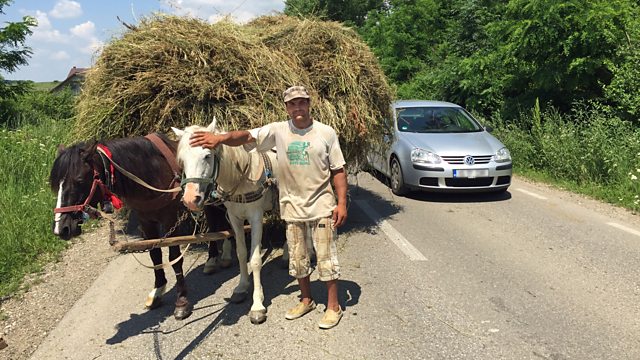
Roads have not improved since the 1989 revolution, while the amount of traffic has increased.  There is not a safe driving culture: people ignore the speed limits and the rules of the road; alcohol and drugs are contributory factors to the high accident rate, while slow-moving horse and carts add to the problem.  Railway crossings without barriers are accident hot-spots claiming an alarming number of lives each year.

Stefan Mandachi, a successful and charismatic businessman, is leading the ‘Romania vrea autostrazi’ (Romania wants highways) campaign to build motorways in the region.  Spurred into action by his inability to reach his dying mother in hospital because of the lack of decent roads, his efforts include a video, billboards and the hashtag #sieu (count me in).  He constructed a symbolic metre of motorway which has become a tourist attraction.

Mandachi says 60,000 people have died on Romanian roads since 1989.  Two thousand die each year, the highest rate per capita in the EU, twice the EU average and 3-4 times the figure for the UK.  Mandachi says that new roads, including motorways, are required, following which bad behaviour should be punished, in order to reduce the number of fatalities and serious injuries.  In March 2019 he called on the country to stop work for fifteen minutes in a bid to persuade the authorities to build motorways

Judging by Dunlop’s interviews with politicians, they seem to be in denial about the problem and refuse to take responsibility, passing the buck for the lack of action.  There is also the issue of the loss of expertise due to migration, including engineers.  Before EU accession there wasn’t the money.  Now there is, but a shortage of skills necessary to develop the country’s infrastructure. 

Commentators agree there is money to address the situation, but feel that governments have not considered it a priority.  Fortunately, the Romanian diaspora is becoming increasingly vocal about corruption and mismanagement at home so perhaps, Dunlop concludes, there is hope for the future.

The programme is available (at the time of writing) on the BBC website: