28 June 2018

Maria (2013)


Maria is a short (19 minutes) documentary made by Claudiu Mitcu, shot on his smartphone.  Maria is an old woman dying at home, watched over by female family and friends who try to make her comfortable.  When they are not doing that they are chatting to each other in the easy manner people who have known each other a long time have.  They talk about Maria as if she were already dead, eulogising her accomplishments and discussing funeral arrangements.  This might seem astonishingly insensitive, but these are tough women and their compassion is of a practical and unsentimental kind.

Maria is conscious but does not seem distressed by what she hears; it is probably similar to conversations she has had herself while nursing dying relatives.  Mitcu sits unobtrusively in the corner filming, and the behaviour of the women is totally natural.  There is nothing prurient or intrusive as the film feels like a respectful act of love.  We do not follow Maria to the point of death, in fact the film breaks off at an arbitrary point mid-conversation, but that is like life: we enter and leave at arbitrary points, and it goes on without us.

The talk turns to personal matters and one of the ladies worries about who will look after her in old age the way she looks after her parents.  Tines are changing; the participants are enacting an age-old ritual, but in some societies it has become far less common than it used to be.  With sophisticated technology increasingly prevalent as we reach the end of our lives we are in danger of losing the human touch that connects us to each other.  Maria is fortunate.  This is how people should die whenever possible, not in a hospital ward but in your own bed, surrounded by those you love, though perhaps not necessarily such chatty ones as these.

Source: YouTube/Cinepub

25 June 2018

Metrobranding (2010)


Subtitled ‘A Love Story Between People and Objects’, Metrobranding is a documentary film directed by Ana Vlad and Adrian Voicu.  It consists of interviews with middle-aged and elderly people reminiscing about the production of goods they helped to manufacture pre-1989, before western-style consumerism hit Romania.  The result of a planned as opposed to a free-market economy, rather than competition for a share of customer spend, Romanians were limited to a single brand for any given product.  To explore this strategy, Metrobranding looks at six particular brands that had monopolies and each of which was produced only in one town: the Ileana sewing Machine, Finca plimsolls, the Mobra motorbike, the Pegas bicycle, the Relaxa mattress, and the Star light bulb.

These were all familiar to the citizens of communist Romania because they were ubiquitous, and this familiarity explains the attachment people still have towards them, emblematic of a vanished era and one evoking nostalgia for many.  Those who were involved in their manufacture look back and see good times for their communities and pride in what they achieved.  They worked hard certainly, but had a sense of purpose.  In a changing world some of the products could not compete, and this is a story of changing tastes and decay more than one of industrial archaeology.  There are many questions raised by the film though little attempt to answer them, but the feeling of loss comes across clearly.

Some of the questions include: Why did old brands fall by the wayside?  Could they not compete with more efficient production methods (the mattress factory is still going, but looks inefficient) or cheap imports?  Does monopoly lead to shoddiness because the market is captive?  Did products simply become unfashionable because of their familiarity, or associations?  Do they have a retro appeal?  What happens to a town reliant on a single commodity when that commodity is no longer viable (one thinks of Detroit here as an example).  When thousands worked in a factory that operated round the clock, what do they do when the factory closes and they lack the skills necessary for other employment?

There is surprisingly little emphasis in the film on the politics which were concerned to build a society that could have its needs met with limited resources, even if much of the output was for export.  This omission is a problem, as decisions about how production should be organised were made centrally, and it is unclear to what extent there is wistfulness for these vanished products rather than for the old political system that authorised them.  Such views were implicit, but not much examined.

Times have changed – school students were sniffy about the plimsolls compared to their trainers even though they looked elegant and well made – but the film does highlight the issue of state planning vs letting the market decide.  We are used to the idea of competition (or at least the notion of competition – there may be cartels at work), but really are we any happier with having massive freedom of choice when it comes to buying a mattress or a light bulb?  Either way, the film has a broader dimension: it may be specifically about a limited range of brands in one country, but it touches on a universal feeling of loss for what is gone, wherever you happen to live and under whatever system of government.

Source: YouTube/Cinepub

21 June 2018

On the Footsteps of the Prince


 Kickstarter funding is being sought for a documentary film, On the Footsteps of the Prince, the prince in question being HRH Prince Charles.  He has visited Romania repeatedly since 1997, and has a holiday home at Viscri in Transylvania.  The idea of the film is to explore why he has taken such an interest in Transylvania, and use his involvement in the region and its conservation as a peg to promote the area further. 

Subtitled ‘The story about a hidden paradise’, which goes some way to answering that question, the film will focus on the landscape which has so captivated Prince Charles.  The intention is to capture ‘the other side’ of Romania which, in the words of the Kickstarter statement is ‘peaceful’, ‘serene’ and ‘beautiful’.

Bucharest-born artist and filmmaker Nono Pirvu Lucian is behind the project and he has launched a campaign to raise £20,000 to fund it.  There are various rewards available to those who make donations.  As at this writing there are not many days left to run and it is fair to say that the total raised so far is well shy of the target.

Tied in with the film there is an associated website, which is still under construction.  It will highlight parts of Romania so far little visited by tourists, with information on suitable places to stay, in an effort to advance the sort of sustainable tourism that Prince Charles is keen to encourage.

It is a worthy project, and it would be good to see it succeed, though I’m not sure Transylvania is quite as neglected as Lucian says.  It has attracted filmmakers in the past, not least Charlie Ottley who made the Wild Carpathia series, for which he interviewed Prince Charles.  I hope the title is amended before the film is released so that it reads In the Footsteps of the Prince.


The Kickstarter page is here:


The project’s website is here:


A press release is on the Digital Journal website:

18 June 2018

The Romanian Centenary Garden


A few days ago (14 June) I visited Belgrave Square in London to see the ‘Great Union Garden’ established outside the Romanian Cultural Institute (RCI), though ‘garden’ is perhaps a slight exaggeration as it is effectively a large planter located on the opposite corner to the Institute’s splendid building.  It is part of a programme put on by the Institute to commemorate the formation of a united Romania in 1918.  The square’s garden is not open to the public, but the Romanian garden lies outside the fence and is therefore accessible.

The planter has been designed roughly in the shape of Romania, ‘stylised’ in the words of the RCI (though you would need a tall ladder or a drone to get the full effect).  The space within contains flowers from all parts of Romania, laid out to mimic their distribution in the country itself.  An adjacent information panel describes the purpose of the project.


The intention is the creation of ‘a botanical metaphor’ of the various provinces that constituted Romania in 1918: Banat, Crișana, Maramureș, Transylvania, Bucovina, Moldova, Bessarabia, Dobruja, Muntenia and Oltenia.  The seeds, while being of species found in Romania, were cultivated in the UK, itself a nice metaphor for friendly relations between the two countries.

The planter is on a busy road, so it is lovely to see plants anyway, but it is a splendid way to publicise a significant date in Romania’s history.  The RCI refer to the garden as an ‘installation’ and their website indicates it will be removed this month, so anyone interested would be best advised to check before visiting it, in case it has been dismantled.

The RCI can be seen in the distance


In addition to the garden, to commemorate the centenary the RCI put on a series of events, including exhibitions, a talk, and a book launch.  The book, which was launched last month, is The Transylvania Florilegium.  Comprising two large volumes, it was inspired by Prince Charles, who thought that some plant species might be vulnerable to changing agricultural practices and suggested a visual record be made both to show the diversity of the region’s flora and to highlight the urgent need to protect the environment.

A selection of 40 of the book’s 124 paintings was put on show in the RCI along with photographs of Bucharest parks, but alas I missed the exhibition by a couple of days.  Still, I was happy to see the Great Union Garden and felt a little bit of the Romanian countryside had been successfully transferred to London’s dusty streets.

8 June 2018

Independența României (1912)


Independența României (Independence of Romania), subtitled Războiul Româno-Ruso-Turc 1877 (The Romanian-Russo-Turkish War, 1877), is a Romanian silent film made in 1912 and directed by Aristide Demetriade (1872-1930).  The subject of the film is Romania’s 1877-8 war of independence from the Ottoman Empire.  An intertitle announces it was made with the support of the Romanian army and with members of the National Theatre in Bucharest (where Demetriade was an actor).

The film opens with peasants dancing and making merry.  But conflict is brewing between Russia and the Ottoman Empire, and the Romanian ruler, Carol I (played by Demetriade himself), summons the Council of Ministers in order to mobilise the army.  There he signs the Declaration of Independence from the Ottoman Empire.  The troops mobilise.  Back at the village an elder breaks into the dancing to read the proclamation, to general celebration by the men, but sorrow from the women.  On a personal level, the hostilities interrupt a love story and the lovers bid each other a sorrowful farewell.

A group of friends go to off to war, but one, Cobuz, falls at Calabat by stupidly sitting on top of a trench playing a pipe while his comrades dance below, making him a target for snipers.  Carol is upbeat, but the Russians get hammered by the Turks crossing the Danube.  At a Romanian camp the soldiers dance (so much dancing) and new flags are blessed.  Grand Duke Nicholas of Russia, commanding the Imperial army, sends a telegram to Carol requesting assistance to fight the Turks who are defending Plevna, and the Romanians cross the Danube on 19-20 July 1877.

The Tsar gives control of the Russian army to Carol so he can command a combined force.  After a lengthy disembarkation sequence, the allies go into battle against the Turks, who are put to flight, the Romanian cavalry wreaking havoc on the enemy.  A Turkish patrol is easily dispatched, once the riders realise they are being shot at.  Osman Pasha, wily leader of the Turks at Plevna, disposes his men, inflicting a reverse on the Romanians.  Carol gives encouragement to boost morale and his troops go on to defeat the Turks at Grivita, capturing the Turkish standard.  The Russians under General Skobeleff attack the Green Mountain.

At the Valley of Weeping the dead and dying litter the landscape until a truce allows the bodies to be buried, while Carol and Tsar Alexander II visit the wounded at a first aid station.  Here our lovers are reunited, as she is a nurse, but alas he is badly wounded.  Meanwhile at Plevna fighting continues with the Turks counter-attacking, pinning down the Russians until the Romanians intervene.  After a fierce battle the Turks capitulate.  Osman Pasha surrenders his sword to Alexander, but the Tsar returns it in honour of his gallant foe.

The Russians and Romanians are victorious, and the defeated Turks are forced to trudge under mounted escort through the snow.  Our wounded soldier and his lady love are on the side of the road returning home when a Russian column passes and the colonel shakes his hand, a token of friendship between the two countries.  A final Intertitle declares: ‘After 35 years the celebration of the independence of Romania’.  The military parade held on 10 May 1912 concludes the film.

Filmed in what was intended to be a realistic documentary style, Independenta Romaniei was propaganda promoting Romanian nationhood; the Russo-Turkish War is firmly referred to as the Romanian-Russo-Turkish War.  It is ambitious in scope for its period, and predates D W Griffith’s The Birth of a Nation, with which it bears some similarities in its epic aspirations though not in mastery of technique, by three years.  Unfortunately Demetriade was no Griffith, consistently employing a static camera with extremely long takes and pedestrian cutting between scenes that fails to generate any dynamism by their juxtaposition.

Additionally the pacing is ponderous as the director wants to make the most of his cast of hundreds, their horses and artillery pieces (if marching is involved, you can be sure that the scene will continue until every man has passed in front of the camera), but he has trouble blocking, often creating uncertainty in the viewer as to what is going on.  The cast occasionally betray their theatrical origins by overacting.

The battle scenes are amateurish to modern eyes and lack tension, failing to capture the kind of energy that Griffith was able to inject into The Birth of a Nation.  Nor does Independența României manage to integrate the national and personal in the way that the Stonemans and Camerons were used to show the effects of the American Civil War on individual families.  However, the project was hugely ambitious and Demetriade did a creditable job bringing this foundational experience of the Romanian nation to life on what was clearly a much smaller budget than Griffith had.  Whatever its flaws, Independența României was well received on its release.

The film is available on YouTube.  The original running time was about two hours but the running time of existing prints is only 82 minutes.    This version has an English translation of the intertitles:


There is a Romanian-language Wikipedia page devoted to the film which is very detailed, much more so than the English-language version:

https://translate.google.com/translate?hl=en&sl=ro&u=https://ro.wikipedia.org/wiki/Aristide_Demetriade&prev=search

30 May 2018

Romania in Bulgaria


During a recent trip to Sofia, Bulgaria, I looked out for references to Romania.  I saw hardly any, which surprised me as Bulgaria and Romania are neighbours, but I got the impression there is little love lost between the two.  I was certainly surprised by a comment made during a day trip to Rila Monastery.  The painted external walls reminded me of pictures I had seen of the painted churches of Bucovina.  When I asked the guide about the prevalence of such churches in the Balkans he was dismissive of the comparison with Romania, which I think he saw as demeaning to Bulgaria.  He then claimed, apropos of nothing, that Romania was a Catholic country.  As over 80% of the Romanian population identify as Eastern Orthodox, compared to only about 5% as Catholic (fewer than Protestants of various denominations) his statement was either supremely ignorant or intentionally misleading.  Either way it was irrelevant to my question.

I did find references to Romania, though I had to look hard.  One was in Krystal Garden Park, opposite the giant head of Stefan Stambolov.  Here, surprisingly, was a series of information boards on Bulgarian studies in various countries, one devoted to Romania and Moldova (shown above).  Fortunately the text on all the boards was in English as well as Bulgarian albeit the former was abbreviated.  The Romania and Moldova one notes the establishment of the first Department of Slavic Studies at the University of Bucharest in 1891, and most of the panel is devoted to a list of those Romanians and Moldovans who have worked on Bulgarian culture.  The Institute of Ethnic Studies in Chișinău is highlighted as another centre for research, and the Society of Bulgarian Studies is included as an important institution in the field.

There were more references to Romania in Sofia’s splendid National Gallery, which has a few works by Romanian artists among its collection, if fewer than I expected.  I recorded those I saw, though I cannot guarantee this is a complete list.  The titles are taken from the caption cards.  Of the 12 pieces, ten were paintings and two were sculptures.  Half of the 12 were by Corneliu Baba (two of which are on loan), two were by Ion Gheorghiu, two by Ion Pacea, and one each by Zoe Băicoianu and Ada Geo Medrea:

Corneliu Baba (1906-97)
– 1907, 1951 (triptych)
– The 1907 Uprising, 1951
– Harlequin, 1970
– The Mad King, 1977
– Maternity, 1979
– Self-portrait, 1981

Zoe Băicoianu (1910-87)
– Woman Bathing, 1940s (sculpture)

Ion Gheorghiu (1929-2001)
– Hanging Gardens, 1973
– Hanging Gardens IV, 1978

Ada Geo Medrea (1917-92)
– Nestinarka, 1950s (sculpture)

Ion Pacea (1924-99)
– The Red Cupboard, 1976
– The Painter’s Tools, no date

The standout is Baba’s large-scale triptych 1907, on loan from a private collection.  Its title alludes to the peasants’ revolt of that year which was brutally crushed.  The three elements are combined pictorially with a common horizon, and a brooding sky conveys menace and a sense of doom.  The larger central panel shows a procession of determined-looking peasants wielding agricultural tools as weapons.  On the left-hand panel a couple are working in a field; the man is rising to his feet and looks as if he might be about to join the demonstrators.  In the distance a man on a horse surveys the scene.  On the right-hand panel two women are surrounded by dead men.  One is standing, imploring heaven, the other crouches over a corpse, her hand covering her mouth in horror.  It is a powerful work encapsulating the heroism and tragedy in a single scene.  The 1907 Uprising from the same year is a smaller work with a similar composition to the tryptich’s central panel, and may be a preliminary study.  It too is on loan from a private collection.

28 May 2018

The ‘Haunted’ Hoia-Baciu forest, Transylvania


Looking into what Romania has to offer in the way of paranormal phenomena, I quickly came across Hoia-Baciu forest.  Close to Cluj-Napoca, it has acquired a reputation over the years which has led to it being dubbed ‘the Bermuda Triangle of Transylvania’.  A website devoted to its mysteries describes it as ‘the world’s most haunted forest’, though how one makes such comparisons is a mystery in itself.  There is a generally uncanny atmosphere, and some of the trees grow in unusual shapes with no obvious reason found to explain it.

The phenomena claimed to have occurred there are many and varied, suggesting it is a ‘window area’, or paranormal hotspot.  There is a supposedly old legend of a shepherd who went missing, which wouldn’t be particularly noteworthy except his 200 sheep went with him.  He is said to have given his name to the forest.  One may be slightly sceptical of the thought of a shepherd in charge of 200 sheep inside a forest.

Its spooky reputation can certainly be traced to the early 1960s when a researcher, biologist Alexandru Sift, said he saw peculiar shadows among the trees and disc-shaped objects above them; unfortunately much of his evidence was lost after his death in 1993.  That reputation really took off in the 1970s, with a number of UFO sightings reported down the years after the publication of a photograph featuring a blob-like, or one could say water-droplet-like, shape by Emil Barnea in 1968 (shown above).

More recently reports have expanded in scope to include apparitions, faces appearing in photographs that were not visible when the image was taken, electromagnetic anomalies, batteries discharging (commonly reported in poltergeist cases), electronic devices malfunctioning, and lights, often orange or red and with no apparent source, being seen.  EVP samples have been captured.

Individuals have suffered unexplained scratches, rashes and burns, nausea, migraines, a feeling of oppression and anxiety, and the sensation of being watched by a ‘presence’.  Many phenomena are thought to centre on a clearing, the poiana rotundă (round glade), where nothing grows – except grass.  This is where Barnea took his UFO photograph in 1968.  Photographs later found to contain human-like shapes are claimed to have been taken at the site.

As the Bermuda Triangle tag suggests, there are said to have been many disappearances – one source puts the figure at over 1,000.  A few people have allegedly disappeared and later been found dead, the cause determined to be suicide.  A popular story is of an unnamed five-year old girl.  No trace of her could be found, yet she reappeared five years later, wearing the same clothes which were in good condition, with no memory of what had happened in the intervening period.  If one wonders about a now-ten-year old child dressed in the clothes of a five-year old, she had not aged so was the same size she had been when she vanished.  There are cases of missing time, visitors not realising how long they have been inside the forest.

A theory has it that the area is haunted by murder victims who are angry at being trapped there, or it is some kind of portal to a malign dimension.  A parallel dimension is a theory held by Dr Adrian Patruţ, a chemist at Babeş-Bolyai University in Cluj, president of the Romanian Society of Parapsychology and an associate member of the Parapsychological Association.  He has written extensively on the paranormal, including the forest, and collaborated on a documentary.

Alan Murdie in his Ghostwatch column in the November 2006 issue of Fortean Times summarises a paper about Hoia-Baciu Patruţ had given to a conference held at Sinaia, Romania, in May that year (although Murdie does not name the event, it was the symposium of the Transylvanian Society of Dracula, at which he also presented a paper).  Patruţ’s paper, ‘The phenomena of the Hoia-Baciu wood, in Transylvania’, described phenomena that, in Murdie’s words, ‘suggest a cross between a UFO window area and a giant natural séance.’  These included ‘strange lights, flying objects with regular geometry and fast-moving apparitions at ground level.’  Of greater concern, Patruţ said that microwave bursts and gamma and beta radiation had been detected, though Murdie adds some of the radiation claims were dismissed by another delegate, Professor Sorin Comorosan (not a Nobel physics laureate as Murdie states).

Patruţ was a prime mover in establishing the forest’s reputation with extreme but unsubstantiated assertions.  In an interview reported by Antena 3 in 2013 he tells of a student in a group with him who, sometime after 1989 (such vagueness does not encourage confidence), had a weird experience.  According to his account they were standing at the edge of the trees, looking at the city.  Suddenly the student went into a trance for an hour and when she woke up she said she had been walking through Cluj as it appeared before and during the war.

Some in the party were naturally sceptical but when she went to pay her bus fare she found in her pocket a silver 100 lei coin bearing the head of King Michael (the last king of Romania), indicating something more going on than retrocognition.  Patruţ does not seem to have been concerned at someone being in a trance for an hour.  One yearns to know more about this incident, and the research the professor undoubtedly did to follow up the student’s time-travelling perambulations by interviewing her and comparing her descriptions with the historical records.  He stated he had not told anyone this before, which is remarkable, nor would it seem had the student said anything.

Patruţ has been most fortunate in the range of his experiences.  In 1975 he had taken a large number of photographs at ruins in the middle of the forest in the company of a group of friends.  Returning a fortnight later, the ruins were nowhere to be found and were never seen again.  Moreover, after some years the images of the ruins dematerialised from the photographs!

Hoia-Baciu’s reputation is making it a popular area with tourists and investigators (none of whom has been reported missing, thank goodness).  Its champions suggest it is starting to compete with the Dracula legend as a lure for enthusiasts to visit Transylvania, though that has to be wishful thinking.  There are organised paranormally-themed tours, and like any ghost walk the wilder stories do business no harm.  Its reputation in that regard was further burnished by its appearance on a Hallowe’en special edition of Ghost Adventures which aired in 2013.  Not all visitors are there in the hope of experiencing a frisson of fear: it is allegedly popular with Wiccans, and some individuals believe there is an energy which can be harnessed to positive ends.

What to make of all this?  As this is Transylvania, with all its cultural associations, one might be forgiven for thinking the forest is a vast, remote place.  In fact it is small, only about a square mile in size, and very close to Cluj, no more than a 20-minute drive.  People from the city picnic and go walking or cycling in it.  This is not the wild Carpathians by any stretch.  In fact ‘Hoia-Baciu wood’ would be a more appropriate name, as Murdie indicates in the heading of his Ghostwatch coverage, though it doesn’t have quite the same ring to it.

Some of the reported incidents can be put down to the usual misperception, coincidence and expectation.  Missing time could be people losing track of how long they have been there.  Woods can often generate the creepy feeling that walkers are being watched, an effect that would be enhanced by the peculiar shapes of some of the trees.  Other aspects are doubtless made up – what are the names of the thousand people said to have disappeared?  A small child reappearing unchanged after a gap of five years suggests kidnap by fairy folk, but spinning a yarn sounds more likely.  The name of this youngster is never provided, even though she would surely have become an instant celebrity.

Lights could reasonably be people with torches glimpsed through the trees, either inside or outside the wooded area, vehicles on nearby roads or aeroplanes landing at Cluj airport (you can fly direct from Luton).  EVP can be captured in all sorts of places, and they possess the same degree of evidentiality wherever they are made.  Photographs of flying geometric shapes could be insects.  Patruţ’s various anecdotes are just that – unsupported anecdotes – so need to be treated with caution, and not taken at face value.  Having said which, the Romanian Society of Parapsychology’s files still sound worth a look as according to Patruţ they contain a number of poltergeist cases unknown outside Romania.

As for the poiana rotundă, forest clearings are not particularly rare and are explainable in environmental terms; anywhere else and it would not be thought odd at all.  Patruţ himself has said that ‘The Hoia-Baciu forest is known for its very, very dry vegetation’ (‘Pădurea Hoia-Baciu e cunoscută pentru vegetaţia ei foarte, foarte uscată...’); he mentioned this in connection with an experience which occurred around Easter 2000 (again maddening vagueness) when with another (unnamed) researcher he witnessed large amounts of sap flowing copiously from ‘thousands of trees’ (‘mii de copaci’) and pooling around their roots.  The following day there was no evidence of this liquid.

Promoters of the mystery say the poiana rotundă is a perfect circle, suggesting an unnatural origin, but a glance at an aerial photograph shows it is not.  This kind of relaxed approach to the evidence is typical of accounts dealing with Hoia-Baciu.  In sum, the contention that it is the world’s most haunted forest (or wood) evaporates on closer inspection, in much the same way Patruţ’s sap did.


Update 23 July 2019: ‘Hoia Baciu: Romania’s Haunted Forest’

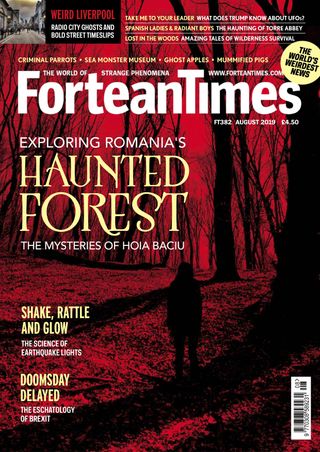
The cover story in the August 2019 issue of Fortean Times is an entry in the magazine’s regular Fortean Traveller section by Chris Hill, devoted to the three-hour visit he made to Hoia Baciu.  It has, he writes, ‘become Romania’s Roswell,’ a startling epithet the article does little to justify, but he does demonstrate why the place is still worth seeing if the chance arises: specifics were less important than the opportunity to soak up the atmosphere.

Following a quick run-down of the region’s complex political history, Hill recounts his experience in the forest.  His guide was Alex Surducan who, with his business partner Marius Lazin, makes part of his living escorting tourists to Hoia-Baciu.  Naturally they have an interest in pressing the case for its paranormal aspects, despite Surducan’s declaration ‘that as a physicist he approached the forest with a scientific eye, allowing speculation in only when all material reasoning had been exhausted.’

Unsurprisingly Surducan knows Patruţ, but these days Patruţ is reluctant to discuss the forest and required some persuasion to talk to Surducan.  Patruţ has moved away from his geophysical ideas, as expounded at the 2006 conference, to a more ‘mystical’ approach involving ‘supernatural accountancy’, with the forest a ‘psychic battery’ fulfilling visitors’ desires.

Surducan pointed out to Hill that conditions in the poiana rotundă were accounted for by the poor soil, despite which he had witnessed both white and black magicians and Christian exorcists engaging in rituals there (perhaps they cancelled each other out).  There has not been much in the way of UFO activity in the forest (contrary to Patruţ’s claim that there was in 2006, according to Murdie’s Fortean Times report) and, drunk teenagers aside, reports in general come from visitors rather than locals, suggesting the role of expectation.

The forest’s use as a general leisure destination is prosaically indicated by the beer tins and vodka bottles Hill saw.  About the only oddities he experienced were a localised breeze rustling in the trees and what he considered undue draining of his camera battery, but he still had a nice time.  As the existence of his article proves, he did not disappear.


Update 5 September 2021:

‘Hoia Baciu: Inside the creepiest forest in Transylvania: Forget Count Dracula’s castle; Transylvania’s really frightful place is ‘haunted’ forest Hoia Baciu. Sophie Buchan goes for a night-time stroll.’

Sophie Buchan produced an article for the Independent travel section on 3 September 2021.  She joined a group led by Alex Surducan on a nocturnal tour of the forest and he was full of his usual stories, starting with ‘“Once when I came here,” says Alex, our guide, “I found 60 people from Bucharest trying to open a gate into another dimension.”’  One wonders how they got on.

Buchan does not challenge the image of the forest as a creepy place where unexplained events happen.  She recounts the usual phenomena hyped-up visitors report, while Alex tells her that ‘ectoplasms’ are ‘routinely’ seen by joggers, though no further details are provided.  Of the photos of ‘shadowy figures’ Alex shows the group, one is a man wearing traditional Romanian dress, so not too shadowy perhaps.

Alex, she decides, while distancing himself from the more ridiculous claims is not immune from the stories.  When she suggests they camp overnight, he makes an excuse about the cold weather.  He tells her he had camped out there, but he and his friends kept hearing the noise of a hoof, which stopped every time they put their heads outside the tent.  Perhaps he wanted to maintain the forest’s mystique, and it might have been dispelled by locals engaged in more mundane activities.

Referring to Emil Barnea, Buchan notes he had nothing to gain by publicising his UFO photograph and much to lose as he was sacked from his job, which would have made his life difficult.  We also learn Alex and Marius are big in Japan as the result of a 2015 documentary about Hoia Baciu shown there.

The article concludes with travel advice and the information that Alex Surducan’s night-time tours cost £25.  Alex says when he and Marius decided to start their business in 2013 their friends told them they were mad, because they thought tourists wouldn’t want to go into the spooky forest.  With prices like that, the friends must be annoyed they didn’t think of the idea first.


Further reading

Website devoted to paranormal aspects of the forest: https://hoiabaciuforest.com/

Adrian Patruţ, De la Normal la Paranormal [From Normal to Paranormal], Vol. 1, Cluj-Napoca: Dacia, 1991.

Adrian Patruţ, De la Normal la Paranormal [From Normal to Paranormal], Vol. 2, 2nd ed., Cluj-Napoca: Dacia, 1993.

Adrian Patruţ, Fenomenele de la Padurea Hoia-Baciu [The Phenomena of the Hoia-Baciu Forest], Cluj-Napoca: Divia, 1995.

Jason Nolan, ‘The Symposium of the Transylvanian Society of Dracula’, 28 March 2006: http://www.lemmingworks.org/weblog/?p=108

Alan Murdie, ‘The Hoia-Bacu [sic] Wood, Romania’, Fortean Times, issue 216, November 2006, p. 24.


Brian Dunning, ‘Solving the Haunted Hoia-Baciu Forest’, 24 May 2016: https://skeptoid.com/episodes/4520

Chris Hill, ‘Fortean Traveller 116 – Hoia Baciu: Romania’s Haunted Forest’, Fortean Times, issue 382, August 2019, pp. 32-36.

Sophie Buchan, ‘Hoia Baciu: Inside the creepiest forest in Transylvania’, The Independent, 3 September 2021.

15 May 2018

Wild Carpathia


Wild Carpathia, written by Charlie Ottley and presented by him on the Travel Channel, is a (currently) three-part documentary series in which he travels extensively around this amazing region of Romania, meeting its inhabitants and exploring the richness of the ecosystem and the culture it supports.  This is a vast area, at 209,000 sq. km almost as big as the United Kingdom.  It is heavily forested, and Ottley emphasises repeatedly that this is the last great wilderness in Europe, home to bears, wolves, lynx, chamois, and even reintroduced bison.

The history of human occupation here is a rich one, and Ottley spends time exploring architectural gems.  Dracula does get the odd mention of course, and the interviewees’ conclusion is that if Stoker’s book encourages tourism, it’s fine.  Ottley’s overriding theme is the interaction of the inhabitants with the landscape, and how they can preserve it while incorporating the best of modernity.  Underneath the travelogue is a campaign to show the dangers the mountains face from unscrupulous exploiters.

He journeys in a meandering arc through Transylvania, Maramureș, Bucovina and Moldavia to the Danube delta.  On the way he interviews a wide range of locals, gaining insights into how they live – those who are pursuing a way of life unchanged for centuries, those fighting to preserve the environment, and those finding new ways to make a living which respect it.  He attends a wedding, spends time with musicians, shares food, and enjoys a drink or two.  Wherever he goes he finds hospitable people possessing a deep love of this beautiful place.

But it is not a rural idyll.  There is hardship and isolation too, people leaving for the cities and to go abroad.  Conditions can be primitive, and isolation make life difficult, especially for the elderly.  Logging is a huge threat, caused partly as a by-product of restitution after the fall of the communist regime, owners taking advantage of their assets, partly the result of local corruption.  Mostly illegal, it is occurring on a vast scale, and it is a theme to which the films constantly return.  Ottley makes clear this is short-term gain bearing devastating long-term consequences.

New roads and unsympathetic buildings are highlighted as issues.  Roads bring in visitors and help to improve the infrastructure, but excessive traffic can have a detrimental effect, and reduces the freedom of movement animals, especially the large carnivores, need to thrive.  The trick is to find a balance between conservation and improvement, and avoid the all-too-common excesses of shoddy building construction, relying on concrete, that is out of keeping with traditional styles.  An effort is being made to educate local schoolchildren, by means of ‘battle buses’, in order to raise awareness of environmental degradation.

Ottley has a relaxed approach and is at ease talking to people from all walks of life, managing to interview HRH Princess Margarita, and Prince Charles twice, the latter claiming to be able to trace an ancestral link to Vlad Țepeș, and therefore arguing he has a ‘stake’ in the country (a joke one suspects he has used before).  One group Ottley does not really address though is the gypsy community, apart from noting they are moving into abandoned Saxon houses, the original inhabitants having left for a new life in Germany.

His enthusiasm is infectious, and this is a great promotional film – at one point he exhorts the viewer to visit and help to preserve the area.  Sustainability is the key, and he stresses the benefits of ecotourism, disincentivising logging and maintaining the integrity of the environment while still generating an income, in the process retaining people and skills for the benefit of all – the visitors, who will value the experience, and the community, which will enjoy a decent standard of living.

While much is at risk of being lost, he argues that this is our common heritage and deserves to be protected.  The biodiversity is staggering, and can be perpetuated by sympathetic management.  Much is being done to encourage visitors, in a way that they will not harm what it is they have come to see, but a lot more is required.  However, the first part of the series was made in 2011, the second and third in 2013, so the dangers Ottley flags up are even more pressing today.

This is a marvellous set of films and it is good to learn there is a fourth instalment in the works, ‘Seasons of Change’.  Ottley is currently attempting to raise the funding for the project, but he began his efforts in 2015, suggesting progress is slow.  One can only hope he achieves his goal, as his aim is again to raise awareness of the ongoing spoliation, and by so doing help to combat it, while advocating alternatives for the prosperity of the inhabitants and the enrichment of us all.


Update: 23 November 2021:

Wild Carpathia 4

Part four of Wild Carpathia, ‘Seasons of Change’, has finally arrived.  It was posted on YouTube on 7 October 2021, and was certainly worth the wait.  The photography is stunning as ever, complete with judicious drone use, and presenter Charlie Ottley is his ebullient self, picking up the themes of the previous episodes and managing to find excellent locations to visit and locals to interview (no Prince Charles this time though).

He sets the scene by noting the extent of the Carpathians, more than half of which are in Romania, and the region having been occupied since the Neolithic period.  Naturally he extols Romania’s vast forests, and their value as a habitat for many of Europe’s remaining large carnivores.  The series’ ecological theme, this precious habitat under threat from neglect and exploitation, is again to the fore.

Rather than a linear geographical structure, Ottley goes season by season.  He begins with autumn, and preparations for winter: the trees changing from green to red, the harvest being gathered, animals brought down from the mountain, the communal slaughter of a pig.  Bears storing up for winter occasionally stray into villages, sometimes having unfortunate consequences.

Winter brings extremely low temperatures.  An Ice hotel in the Făgăraș mountains is an intriguingly eco-friendly tourist option.  It is only standing for a few months and is one for the younger visitors by the look of the crowd.  Other parts of the Carpathians are less accessible at this time of year, but offer opportunities for the adventurous and well-prepared.

During the hard months, feasting takes on a ritual significance as a communal activity.  Ottley points out the people’s intimate connection to the food they eat and where it comes from, in a way that has been lost in many other countries.  The strong sense of community and need for relief means Christmas is celebrated with gusto.

Spring, and nature bursts forth, while communities cut off during the winter months can re-establish contact.  Sheep are driven back up to the alpine meadows and bears awaken.  They are still under threat, both from hunting and habitat loss, but offer tourism opportunities, along with other wildlife, including bison.

While some parts of the Carpathians are disappearing under concrete, unsympathetic developments which hamper communities’ opportunities for cultural tourism, there is increasing awareness of the value in preserving the integrity of the environment.  More projects are being developed that seek to maintain a harmonious relationship with it. 

The tourist industry is growing, stimulating such efforts.  Yet a tree house complex blending seamlessly into its surroundings had more trouble obtaining planning permission than a concrete block hotel would have, so a more sympathetic attitude by the authorities will be required if developments in keeping with their context are to be the way forward.

But sustainable tourism should concentrate on preservation and restoration rather than new developments, and income from tourism helps to maintain the architectural heritage.  Ottley visits an estate which has been beautifully restored since its restitution in 1998, containing accommodation for tourists within an extensive wooded animal sanctuary.  The owner’s vision is for a tourist destination on a par with Tuscany or Provence, a reasonable aspiration one feels.

Cund is a Saxon village where a German, going against the flow of many ethnic Germans who have left the country, has set up a successful guest house, thereby encouraging other inhabitants to follow suit.  The result of increased prosperity and employment opportunities is that not only has depopulation, a problem elsewhere, been halted, it has reversed, young families moving in and houses being renovated.  Visitors are not solely foreigners – about 50% are Romanians exploring their own country.

William Blacker, author of Along the Enchanted Way and champion of preservation, notes the loss of many of the old houses since he first came to the country, and thinks how sad it would be if such buildings vanished completely.  By far the preferred option is to repurpose them for modern living and for tourists.  A kiln producing traditional roof tiles provides local employment, and retains skills, and the tiles are no more expensive than poorer-quality ones made elsewhere.

These are promising signs, but it is not all rosy.  Illegal logging is increasing, and Ottley is shown a mountainside which has been entirely denuded.  It can be done very quickly, authorities turn a blind eye, and multinational corporations are complicit.  Inadequate legislation is exacerbated by small fines, so preservation needs stronger legislation and better enforcement.

As such tracts of virgin forest gone from the rest of Europe, preserving this beautiful but fragile ecosystem is more than a Romanian concern, it is an international one.  An interviewee says there needs to be greater recognition that the forest is not timber and the wildlife is not game; another puts it: ‘Romania is the custodian of a priceless treasure’.

Opportunities unfortunately are being missed.  Abundant wildflowers indicate a high degree of biodiversity, and unpolluted pesticide-free meadows could be a boon for farmers who should be able to charge a premium for their organic produce, especially if tied to traditional cuisine.  But this is not happening, while inferior food is being imported from other countries.  Clearly there is still much to do.

Ottley and his team have made other films promoting Romania, but the Wild Carpathia series is their finest achievement, a lyrical hymn to this beautiful region that makes one want to follow in his footsteps.  Ottley neatly presents a holistic overview of the problems and opportunities, and indicates ways prosperity can be pursued without degrading the environment.

It was a long wait for this instalment, but it was worth it.  Despite saying number four is the last, it would be wonderful if he could make further films exploring the Carpathians.  The Romanian tourist board should take note, and seriously consider providing funding for this champion of the country’s natural capital, while the government would do well to ponder the lessons of the series and stand up to those who seek a quick profit at the expense of everyone else.


https://thomasruffles.blogspot.co.uk/2018/05/along-enchanted-way-romanian-story-by.html


8 May 2018

What Can or Cannot Be Said About Romanian Literature? Plenty, by Saskia Vogel, 2013

Saskia Vogel’s article, dated 3 October 2013, noted that Romanian literature was on a roll, with Mircea Cărtărescu and Norman Manea achieving a significant profile at the Gothenburg Book Fair that year, but she saw a split between how Romanian literature was perceived at home and abroad.  The following astonishing exchange suggests an attitudinal problem on the part of those who should be putting their weight behind the promotion of their authors (though the constant references to Manea and Müller in articles dealing with Romanian literature is to my mind problematic as both have lived abroad for many years):

‘In one feature that tried to give an overview using Herta Müller and Cartarescu as touchstones, Gothenburg Post journalist Sinziana Ravini had a curious encounter with the head of the Romanian Cultural Institute in Paris. He described a boycott by Romanian authors as a ‘fart in Romania’s history.*’ He dismissed the supposed greatness of Cartarescu with the statement that writers don’t want to represent their countries, only themselves. After she asks him to name a few authors worthy of the epithet ‘great’ he recommends three books that she can’t then find at the cultural institute’s library.’

A panel at Gothenburg on what was unique about Romanian literature produced waffle, with Cărtărescu stating it is unique because “Being a marginal language is unique,” which is meaningless in any language, and the panellists were reduced to quoting poetry.  To be fair, it is not a question a writer should be expected to answer.  Vogel considered ‘they conveyed a sense of a simmering avant-garde’.  It certainly appears the writers had more faith in the idea of Romanian literature than the supposed guardian of the national culture in Paris had.

Vogel interviewed Daniela Crăsnaru, who was on the panel.  Crăsnaru suggested that literary productions were now personal expressions of the author’s values rather than the collective values of past generations: the solidarity engendered by the courage required to write under communism no longer exists.  Perhaps this individualism was something the head of the Parisian RCI found distasteful?

This was at a time when there was increasing interest in Romanian literature in other European countries (particularly Sweden), with it being the focus at several book fairs, enhanced by Müller’s Nobel win in 2009 drawing attention to Romanian literature.  Promotions at book fairs and the efforts of the Swedish RCI had been instrumental in increasing numbers of books by Romanian authors being translated in a variety of languages.

The head of the organisation in Stockholm was upbeat about the prospects for Romanian literature:  ‘We believe culture to be Romania’s big chance to conquer the world, with literature playing a major role in the process.’  Full marks for ambition, and a more positive attitude than his counterpart in Paris!

Source: Publishing Perspectives


*Vogel does not say what the boycott was all about but the Sarah in Romania blog of 20-22 March 2013 had a full account of what happened.  The RCI’s president, Andrei Marga had been embroiled in a number of scandals and his autocratic style had not gone down well with those he was supposed to represent.  A reorganisation the previous summer had already provoked an outcry among creative individuals, causing a number to sever ties with the Institute.

Marga, having previously served as foreign minister, was a political appointment, and there was disquiet at the perceived politicisation of culture he represented, and the change in the goal of the ICR to ‘preserve national identity’, rather than support independent artists as it had been doing, caused further protests.  This was a sensitive issue as it was read as a throwback to the communist era, with grumbles of a personality cult developing around Marga.

The result was a decision by a number of high-profile figures, including Cărtărescu, to boycott the 33rd Salon du Livre in Paris in March 2013.   When the Salon opened, a group of Paris-based artists (not only Romanian), under the banner ’ICR OFF!’, held pictures of absent authors over their own faces in order to support them and protest peacefully at the way the ICR was being run.

There were unpleasant scenes as the protesters were roughly removed by overzealous security guards minutes before President Hollande arrived at the Romanian section.  Despite these problems the event was a success, notwithstanding the absence of some of Romania’s best-known writers, and a fine showcase for Romanian literature which proved popular with visitors, featuring interesting talks by those authors who did attend, and long queues forming to purchase books.

As for Marga, a report on the Romania Insider website carries the news that he resigned in June 2013 after only nine months in the job.  He may have jumped before he was pushed.  In the self-serving official release he highlighted positive contributions he felt he had made to the life of the ICR, but referred to attacks made on him from the moment he was appointed, as well as to budgetary constraints and bureaucratic difficulties.

He shrugged off his critics by claiming: ‘I was talking to them about the infinite and they kept reminding me about the length of my trousers’, which sounds odd for an administrator to say about authors.  One would expect it to be the other way round.

7 May 2018

A Cultural Journey, Ministry of Regional Development and Tourism, January 2011

Subtitled ‘Romania: explore the Carpathian Garden’ and published by the Ministry of Regional Development and Tourism in January 2011, this is one of a series of guides promoting Romania to foreign visitors. Accompanied by attractive photographs, it provides a brief overview of the country with the emphasis firmly on tradition.  It begins with basic facts about Romania: size, population, cities, currency, holidays, etc., before moving on to provide snapshots of this unspoiled corner of Europe.

Sections look at castles, fortresses and fortified churches; monasteries; Maramureş; Sarmizegetusa; Roman remains; folk traditions; ethnic minorities and museums.  Basic information on travel, opening hours and local accommodation is included.  There are profiles of a number of distinguished Romanians in the fields of science, technology, literature and music.

Interweaved is the history of the country from prehistoric times which shows how it has been contested over the centuries but how these influences have shaped its unique identity.  It is noteworthy how much is on UNESCO’s heritage lists of both tangible and intangible assets.  There is a lot more to the country than just Bucharest and Transylvania.

There are suggested itineraries for self-directed tours to see various parts of the country, showcasing its cultural gems.  The booklet concludes with a list of Romanian tourist information offices abroad.  There is little detail, merely a quick paragraph on each topic, but enough to stimulate interest to know more.

Source: Issuu


(This was first published on The Joy of Mere Words, 6 May 2018)